

15% Off ~ Use Code: VIP15
Why Hand-Stitched Leather Lasts Longer
Why a Hand-Stitched Wallet Will Outlive Just About Anything You Own
You’ve probably had this happen: a wallet or bag falls apart after a year or two, right along the seam, while the leather itself still looks fine. That’s not bad luck. It’s math. Most factory-made goods are built with a single thread run through a sewing machine and a “leather” that isn’t really leather at all. Hand-stitched leather made from real, vegetable-tanned hide is a different story — and once you understand what’s actually holding each type together, the difference between something that lasts five years and something that lasts fifty stops being a mystery.
Hand-Stitched vs. Machine-Sewn Leather: Why Craftsmanship Lasts Longer
Why Hand-Stitched Leather Doesn’t Unravel
Here’s something most people never think about: a sewing machine ties every stitch with one continuous thread, looped through itself stitch after stitch, like a chain. Snag it in one spot — a stray fingernail, a keychain, a bit of friction against a car seat — and you can watch the whole seam unravel in front of you, one stitch pulling loose after the next.
Hand stitching, the kind we use on every piece at Middleton Artisan Leather, works completely differently. It’s called a saddle stitch, and it’s been the standard for leather goods that actually need to hold up — saddles, harnesses, tool belts — for centuries, long before anyone had a sewing machine to reach for. Two needles, one on each end of a single waxed thread, pass through the same hole from opposite directions. Each stitch locks itself in place independent of the ones next to it. Cut a saddle-stitched seam in the middle, and the rest of it stays put. Nothing unravels, because nothing was ever relying on its neighbor to stay tied.
It’s slower. There’s no way around that — a skilled hand can only push a needle so fast, and unlike a machine, it can’t be rushed without ruining the line. But slower is kind of the point. You’re trading a few extra minutes of work for a seam that will outlast the rest of the piece.
Then There’s the Leather Itself
Thread only matters if what it’s holding together is worth holding together. This is where “vegetable tan” leather and “PU leather” stop being interchangeable marketing terms and start being two genuinely different materials.
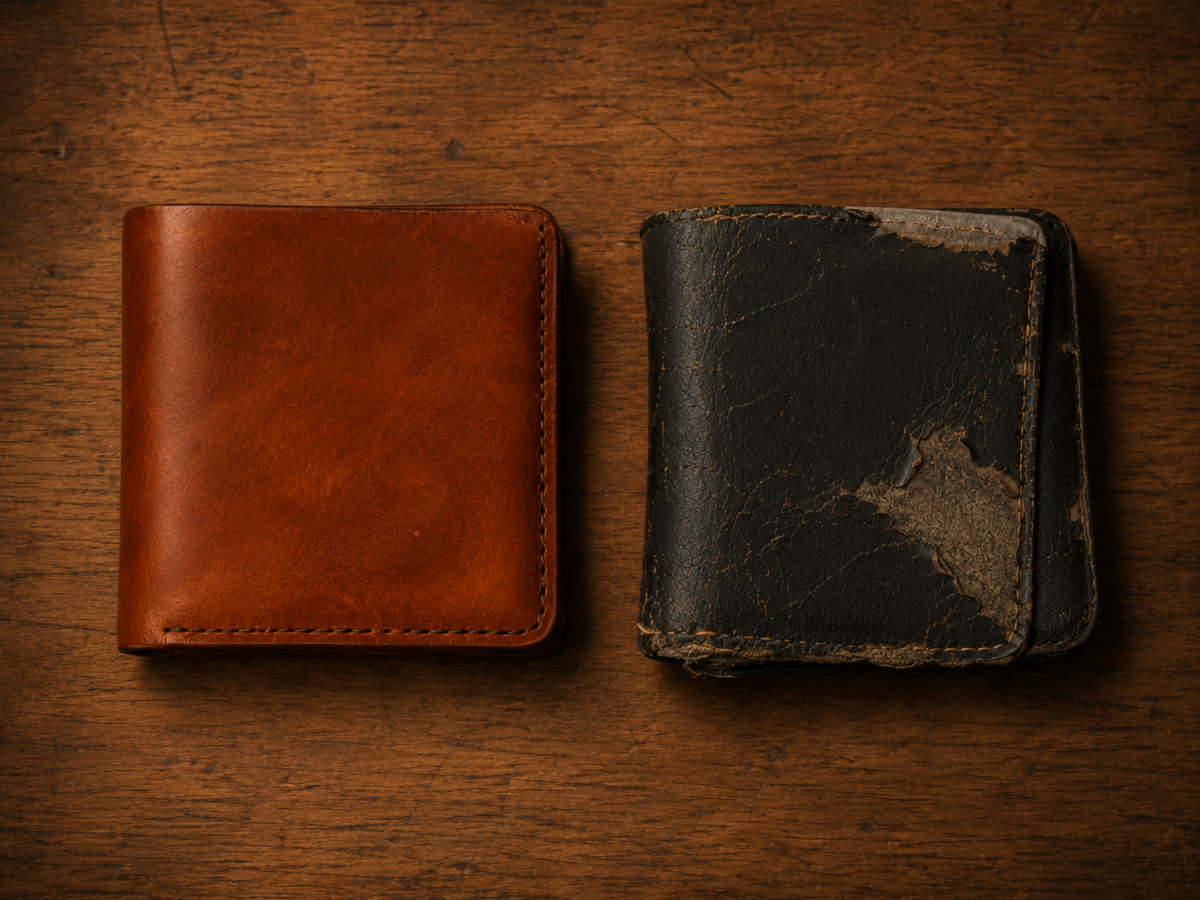
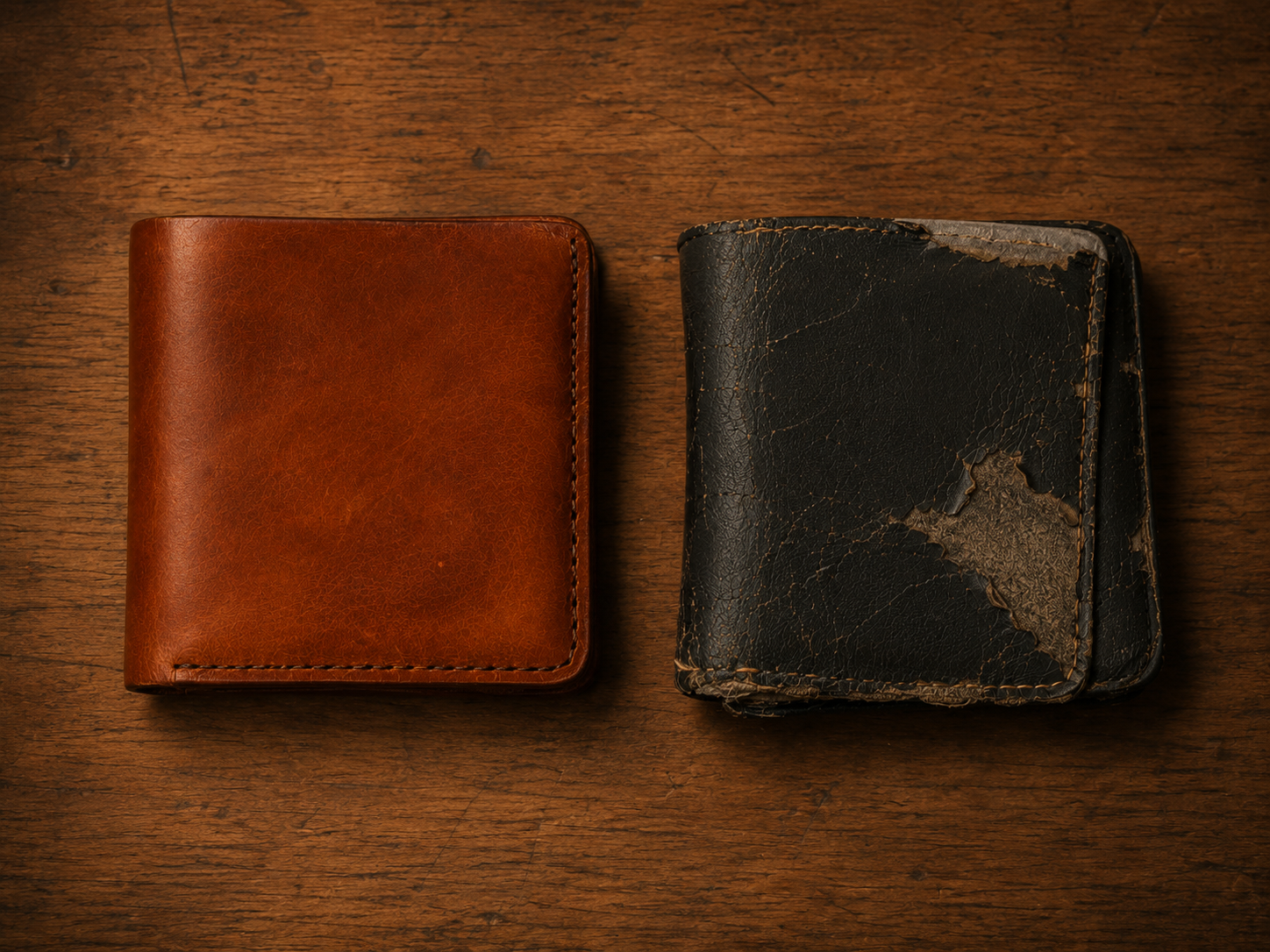
Veg tan leather is tanned the old way — using tannins pulled from tree bark, wood, and other plant material, a process that can take weeks. What comes out the other end is a thick, full-grain hide that starts out fairly light and stiff, and then does something no synthetic ever will: it changes. It darkens, it softens, it picks up a sheen from your hands and your pocket, and over years it develops a patina that’s completely unique to how you used it. A veg tan wallet at year five doesn’t look worn out — it looks better than the day you bought it.
PU leather (short for polyurethane, and sometimes just called “faux leather” or “pleather”) is a plastic coating pressed onto a fabric or paper backing to look like leather from a few feet away. It’s cheap to produce, which is exactly why it shows up in so many mass-market goods. But it doesn’t age — it degrades. Give it a couple of years and the surface starts to crack, peel, and flake, because you’re not looking at a material that ever had the structure to bend and flex for decades. It was never meant to. It was meant to look right in a product photo and get you through the return window.
We work with tanneries that have spent generations perfecting this — Badalassi Carlo’s Pueblo, Minerva, and Buttero leathers, Horween’s Dublin and Crazy Horse, Conceria Walpier, and chèvre goatskin for pieces that need to be thinner without losing strength — sourced through trusted suppliers like The Tannery Row. None of it is the cheapest option. All of it is chosen because it’s still going to be doing its job well after most wallets have been thrown away.
What This Actually Means for You
Put those two things together — leather that gets better with age and stitching that doesn’t fail stitch by stitch — and you get hand-stitched leather that’s genuinely built to be repaired rather than replaced. If a saddle-stitched seam ever does wear through after years of hard use, a leatherworker can re-stitch that exact section without touching the rest of the piece. Try doing that with a machine-sewn seam on bonded PU — there’s usually nothing structurally sound left to repair, and the backing material has often already started disintegrating underneath the coating.
It also changes how you think about cost. A $250 hand-stitched veg tan wallet sounds expensive next to a $25 one from a big-box store, until you consider that the $25 one will be cracked and in a landfill within two years, and you’ll buy three or four replacements before the hand-stitched one shows its first real signs of wear. Priced out over the years you’ll actually carry it, quality leather is often the cheaper option — it’s just not cheaper on day one.
That’s really the whole philosophy behind how we build things at Middleton Artisan Leather. We’re not trying to make something that looks good in a photo. We’re making things that are meant to be handed down — a wallet that ages into your hands, a notebook cover that gets more character every year you carry it. That’s why every stitch is done by hand, and why every piece we make is backed by a one-year warranty on stitching and hardware. We’re confident in it because we know exactly how it’s built, and what it’s built to do.
If you’ve never held a genuinely hand-stitched, veg-tan piece next to a mass-produced one, the difference is obvious the second you pick both up.
One feels like it was made to be used for a decade. The other feels like it was made to be sold.
That’s the standard we hold ourselves to, and it’s why we consider Middleton Artisan Leather the premier choice for hand-stitched leather goods built to last. Every wallet, notebook cover, eyewear case, and keychain we make is saddle-stitched by hand from full-grain veg tan leather — no shortcuts, no PU, no machine-run thread waiting to unravel. Browse the full collection at middletonleather.com and see the difference for yourself.